The scent of salt and the distant hum of a fishing boat define the morning air along the coast of Luwuk, a port town that acts as the gateway to the Banggai archipelago. Here, the equatorial sun warms the land, inviting exploration of both the mainland’s verdant interior and the coral-rich waters offshore. This region, distinct in its geography and biodiversity, provides a compelling focus for those drawn to Indonesia’s lesser-explored reaches.
Luwuk: Gateway to the Banggai Archipelago
Luwuk, the capital of Banggai Regency, is strategically positioned on the eastern arm of Sulawesi, serving as the primary administrative and economic hub for the surrounding area. The town itself spans an area of 72.82 km², a compact urban center that facilitates access to both the mainland’s natural attractions and the remote Banggai Islands. Its geographical coordinates, precisely 0°55′48.32″S 122°47′45.96″E, pinpoint its location maritime Southeast Asia. The climate here is consistently tropical, characterized by warm temperatures and regular rainfall throughout the year, typical of an equatorial zone. From Luwuk, travelers can arrange onward journeys to the islands, which are administratively distinct as Banggai Islands Regency, underscoring the regional nuances in Indonesian administrative divisions. The mainland Banggai Regency, for which Luwuk is the capital, had a 2020 census population of 362,275, demonstrating a significant human presence within its extensive 9,672.70 km² land area. This mainland also features an impressive 613.25 km of coastline, offering numerous points of departure and coastal exploration opportunities.
Connectivity and Travel Logistics
Reaching the Banggai archipelago from Luwuk typically involves a combination of land and sea travel. Luwuk is served by Syukuran Aminuddin Amir Airport (LUW), which connects the region to major Indonesian cities like Makassar and Palu. From the airport, transport into Luwuk town is readily available. The town’s port functions as a crucial transit point for ferries and smaller vessels heading to the various islands of the Banggai group. These connections are essential for both local communities and visitors, linking the mainland’s infrastructure with the more isolated island environments. Planning for these sea transfers requires attention to schedules, which can be influenced by weather conditions. The journey itself offers views of the rugged coastline and the expansive blue of the Celebes Sea, gradually revealing the scattered islands that lie eastward.
The Endemic Banggai Cardinalfish and Reef Diving
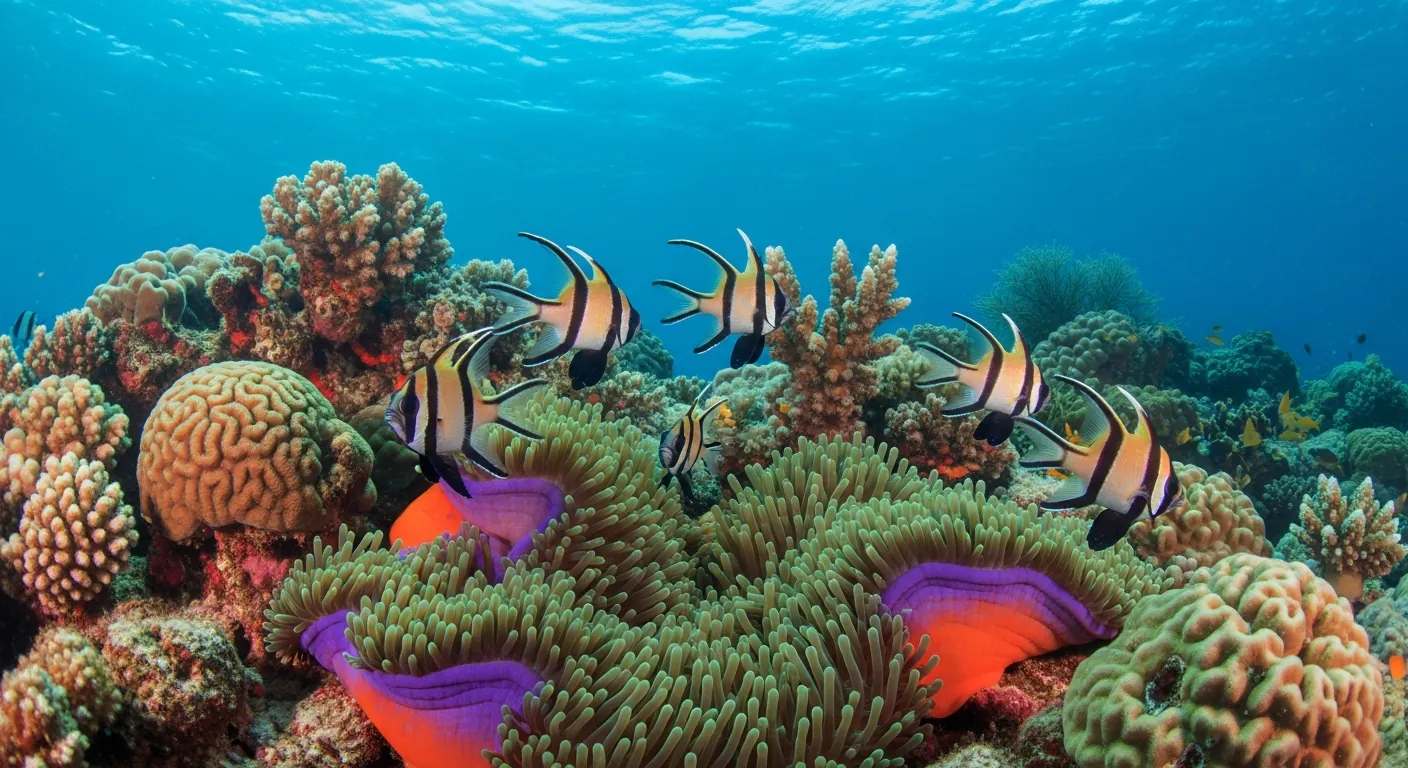
The waters surrounding Luwuk and the Banggai Islands are globally recognized for their exceptional marine biodiversity, particularly for being the natural habitat of the Banggai cardinalfish (Pterapogon kauderni). This small, strikingly patterned fish is endemic to this specific region, making it a focal point for conservation efforts and a primary draw for divers. Its unique reproductive strategy, where the male mouth-broods the eggs, further distinguishes this species. Diving in these waters offers the opportunity to observe these cardinalfish in their natural environment, often congregating among sea urchins or branching corals in shallow, protected areas. Beyond the cardinalfish, the reefs teem with a diverse array of marine life, including various species of nudibranchs, crustaceans, and reef fish, alongside healthy coral formations. The visibility in these tropical waters is often excellent, extending beyond 20 meters on calm days, allowing for clear observation of the intricate underwater ecosystems. Dive sites range from shallow coral gardens suitable for beginner divers to deeper walls and pinnacles for more experienced enthusiasts. Conservation initiatives are active here, aiming to protect the fragile reef systems and the endemic species that call them home from threats such as overfishing and habitat degradation.
Coastal Charms: Kilo Lima Beach
Kilo Lima Beach, located just a short distance from Luwuk, offers a tangible example of the region’s coastal appeal. This accessible stretch of sand provides a place for relaxation and local interaction. The beach is characterized by its dark sand, a common feature along many Indonesian coastlines due to volcanic activity. The water here is typically calm, making it suitable for swimming and wading. Local vendors often offer refreshments, contributing to the beach’s welcoming atmosphere. It serves as a popular spot for both residents of Luwuk and visitors seeking a convenient escape from the town’s more urbanized areas. The name “Kilo Lima” refers to its approximate distance from a central point, illustrating a practical naming convention. Sunsets over Kilo Lima Beach are particularly notable, casting a warm glow across the water and the distant hills. The beach functions as a community gathering place, particularly in the late afternoons and evenings, where families and friends converge. Its proximity to Luwuk makes it an easy excursion, often reached within a 15-minute drive from the town center.
Salodik Waterfall: Inland Exploration
Inland from Luwuk, the landscape transforms into lush tropical rainforest, where natural features like Salodik Waterfall await discovery. This multi-tiered waterfall is a refreshing counterpoint to the coastal environment, offering a cooler, shaded retreat. The journey to Salodik typically involves a drive through undulating terrain, passing through small villages and agricultural plots. The waterfall itself cascades over several rock formations, creating natural pools at its base where visitors can swim. The surrounding vegetation is dense, characterized by towering trees and epiphytic plants, indicative of a healthy rainforest ecosystem. The sound of rushing water and the calls of unseen birds contribute to the tranquil ambiance. Access to the waterfall involves a short, relatively easy trek from the parking area, making it suitable for most fitness levels. Salodik is not merely a scenic spot; it is also a source of fresh water for local communities and a place for recreational activities. The air here is noticeably cooler and more humid than on the coast, providing a welcome change, especially during the hotter parts of the day. The site is maintained with basic facilities for visitors, ensuring a comfortable experience while preserving the natural integrity of the area.
Banggai Regency: Geography and Administration
Banggai Regency, with Luwuk as its capital, is a significant administrative division within Central Sulawesi, Indonesia. The regency encompasses a substantial mainland area of 9,672.70 km², extending across the eastern arm of Sulawesi. This vast expanse includes a diverse geography, ranging from coastal plains to mountainous interiors, characterized by tropical rainforests and agricultural lands. The regency’s coastline measures 613.25 km, indicating extensive interaction with the sea and numerous coastal communities. Administratively, Banggai Regency is distinct from the Banggai Islands Regency, which governs the archipelago itself. This distinction is important for understanding regional governance and resource management. The 2020 census recorded a population of 362,275 for Banggai Regency, reflecting a vibrant community engaged in various sectors, including agriculture, fishing, and trade. The regency’s position on Central Sulawesi’s eastern arm places it in a region known for its rich biodiversity, both terrestrial and marine. Its administrative structure, typical of Indonesian regencies, oversees local governance, infrastructure development, and public services for its inhabitants. For further information on Luwuk, consult Wikipedia’s entry on Luwuk. Additional details on the broader Banggai Regency can be found on Wikipedia’s Banggai Regency page.
Navigating Central Sulawesi and Regional Context
Central Sulawesi, as a province, provides the broader geographical and administrative context for Luwuk and the Banggai Islands. Located centrally on the island of Sulawesi, the province is characterized by its elongated shape and diverse topography, including several mountain ranges, extensive coastlines, and fertile valleys. The climate across Central Sulawesi is predominantly tropical, influenced by its equatorial position, leading to consistent warmth and high humidity. The regional geography impacts travel and accessibility, with major towns often connected by coastal roads or inter-island ferries. Luwuk’s position on the eastern arm makes it a key transit point for the province’s eastern maritime routes. Understanding the regional context of Central Sulawesi is crucial for appreciating the logistical challenges and opportunities present in visiting remote areas like the Banggai archipelago. The province is divided into several regencies and cities, each with its own administrative capital and unique characteristics. The administrative divisions in Indonesia are hierarchical, with provinces overseeing regencies, which in turn manage districts and villages. This structure provides a framework for understanding local governance and resource allocation across the vast and geographically complex Indonesian archipelago. For more information, explore resources like Wikidata’s entry on Luwuk.
To continue planning your journey through this unique part of Indonesia, explore further details on luwukbangaiisland.com.